Posts

What Constitutes Change?

Image
Today we had a very interesting discussion during our skype session centered around the topic of change, both in our work and our practice. I first posed the question of:  What constitutes change in our professional practice as a result of the learning and reflection accumulated through this course? For me the changes we are expected to see contradicted the framework of my research project in which I conducted an ethnographic study within my professional practice and took care not to alter my surroundings through my observation and questioning in order to provide a true representation of my work environment free from unfamiliar bias. Are things really changed by one simply observing it?  Even if a researcher evokes change, is it significant in comparison to the wider field of knowledge? Is the researcher merely a small piece in an infinite  puzzle or wider learning? Adesola voiced a school of thought that as a researcher you are fundamental to your field and your...

Quality not Quantity

Image
As I continue on this journey through module three and my research project, what keeps being confirmed to me is the well known adage of "the more you learn, the less you know".  This is something that has arisen throughout my time on the MAPP course and as I continue reading literature pertaining to my research topic I am continually being led down roads or further reading on associated topics. But when should I stop? It was made very clear that when researching a chosen subject over 10 weeks there will always be a constraint on the amount of research one can achieve and the detail one can go into in a realistic time-frame. I see this research project as a tree forming on the surface with the roots being the theories and literature I am coming across to support and substantiate it's existence. Further reading leads to further growth and further off-shoots into subjects I never realised could relate to my field. These roots could keep going on forever encompassing ...

Beginning Module Three

As I commence Module Three my thoughts are overwhelmed with eagerness and anticipation for what seems like the mammoth task ahead. Wanting to swiftly get stuck into the research process, I have to remind myself of the comprehensive plan I set out in my Module Two research proposal. Reflecting back on previous terms and the beginning of term Skype discussion, it is the learning journey itself and not the final destination or answer that is of most benefit. As Adesola said in the Skype session, it is the uncomfortable feeling of not knowing that will lead to further knowledge. These journeys will rarely lead to an answer but merely more questions and more avenues of learning...

Communicating Ideas

Last Sunday's Skype session saw, what I felt, was a very difficult and thought provoking discussion on communicating ones ideas. The discussion revolved around the different ways one communicates their ideas throughout this course and how they grow through each module. One aspect which I feel resonated with most of us were the differences in communicating our own views and opinions within our work and the communication of other peoples ideas and theories. These seemed to differentiate between the formal citing of theories and frameworks and the informal personal views and reflections. It seemed key to making these areas work in harmony within your work was to not see them in isolation but rather as a fusion of voices. This fusion appears to become more apparent as the course progresses from our RPL claims in module one, our research proposals in module two and the research project, professional artifact and presentation in module three. One idea I felt was that the time in betw...

The Question of Ethics

On Monday evening we had a skype session on ethics, with a focus on the MORE form process within our research proposal. We discussed how it was particularly important to understand the differences between Ethical Considerations and Ethical Processes; something I feel I may have misunderstood in the drafting of my first research proposal. Ethical Considerations are the thoughts of the enquirer regarding how their research methods may impact it's participants. Whether through questionnaires, interviews or observation, it is important to consider if your modes of inquiry may implicate it's participants, put them in a stressful or demanding situation or have a negative impact. In the selection of participants one may even be inadvertently causing exclusion or dis-justice to various other groups. Ethical Processes are the actions and processes one may go through in-order to avoid any negative impacts as mentioned above. This may include ensuring confidentiality or anonymity of p...

The Learning Process

Sunday's monthly MAPP discussion group revolved around the topic of 'knowing and learning' within our practice and within the course. The conversation gravitated towards two different schools of thought in relation to learning: Learning in order to be assessed. Learning in order to grow and gain perspective on your knowledge. We established that the majority of learning is undertaken with the aim of eventually being assessed on how much of that knowledge is retained and replicated. This rung truths with most of the dance teachers in the discussion as they admitted that within their practice more emphasis is placed on preparing students for examination of a set syllabus despite the teachers themselves finding more reward in seeing their students grow and apply knowledge learnt to their own bodies in a unique way. This drew parallels with something I am currently reading about as I start Module Two: Positivist and Non-Positivist approaches (which I will be blogging a...

Art's Critical Value: thoughts

Adesola's blog post "John Green - The Test - capacity to make connections." asked us to consider the role of arts or creative thinking in education. As I embark on module two I am looking carefully, not only at the course content that lies ahead, but also the qualities I possess (often without knowing) that can be of most use to me on the MAPP programme and that I can incorpor ate into further learning. The TED talk Adesola introduces to us in her blog shows Cindy Foley discussing the importance of creativity in education. In it Foley says that more increasingly creativity is being touted as the key to student success, economic growth and general happiness and she further advocates that the key to this creativity are three key traits that often come naturally to artists: Comfort with Ambiguity. Idea Generation. Transdisciplinary Research. On reflection and comparison to my own practice, I came to the realization that these are qualities that as I dancer I h...

“You don’t have to be great to start, but you have to start to be great.” –Zig Ziglar

Friday saw the first Skype session of the 2019/20 academic year consisting of a welcome induction by Adesola Akinleye. Akinleye proceeded to introduce everyone and familiarize new students with aspects of the course and also myunihub. I feel an orientation of myunihub is always helpful regardless of where you are in the course as the maze of a system can always confuse even the most experienced of users. Looking at the semester ahead and future assignments and deadline the same daunting feeling I felt at the beginning module one started to come across me, so it was good to be amongst peers new and old to remind myself that this was all part of the learning process. The usual anxieties of juggling the MAPP workload with professional/ family commitments arose during discussion and when Akinleye was asked how many books we need to be reading for each module she reminded us that the course isn't about reading a set number of texts but rather making meaning of your professional prac...

Theories and Framework

Sunday's monthly MAPP discussion saw us reflect on the subject of theories and framework, not just in our learning or professional practice but as our lives as a whole. Theories are a part of everything we do and on reflection it seems as we become more experienced in our field, we come into contact with many more theories that we can either choose to adopt or strengthen the use of our existing theories. Continued exposure to and questioning of different theories can lead to a growth in the framework that one adopts in their daily practice. But what defines a framework and how large a part of our lives does a framework encompass? We discussed that frameworks can cover huge areas of our lives and that the frameworks we see in our everyday lives can relate to and be part of even larger frameworks, for example: the world we live in could be classed as a framework and within that you have much smaller frameworks such as evolution or human development.; similarly to a child wh...

Connectivism and Combinatorial Creativity

Image
In a blog post by Adesola Akinleye, Connectivism is looked as a fundamental feature of the MAPP course. Akinleye uses two theorist's ideas on connectivism to establish how they are linked to our practice within dance. George Siemens sees connectivism as a means for a more socially connected process of learning that can eliminate a contrived instructivist or self-regulated approach. This can take many levels; at a biological level where neurons are firing and forming new connections to networked learning where one takes concepts and applies them to their pre-established understanding to form conceptual connections. Most commonly connectivism is seen everyday in networked learning from external social platforms (blogs, social media etc.) This Combinatorial Creativity can be applied to how dance has evolved over time. At a biological level, a sense of movement is instilled in everyone at birth and dance has been seen in the earliest of records. As dance has evolved, networked lear...

Discussion- Learning in and as professional practice

Image
On Tuesday we had a discussion session with Adesola with a focus on module one (DAN4510). Adesola started by asking if we had any questions regarding the module and it seemed the majority of us weren’t too sure of the difference between our AOL submissions and the Recognition of Prior Learning essay. It soon became clear to us that the RPL essay was rather an articulation of the theory behind our current practice and how we would contextualise what we know; whereas the AOLs were specific to each area knowledge and the experiences that allowed this learning to come about. Later in the session, Adesola showed us a TED talk conducted by Ken Robinson on the subject of Changing Educational Paradigms. His talk went on to describe how the current educational system wasn’t fit for purpose and that there was a divide between young learners who are classed as ‘academic’ and those classed as ‘non-academic’ From a young age, children are deemed best suited to jobs that are either ‘intellectual’ o...

Sunday Discussion- Knowing and Learning

Image
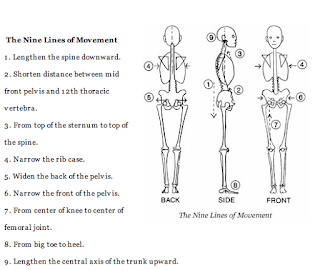
Sunday evening saw us have our monthly MAPP discussion group which was based upon the topic of 'Knowing and Learning'. After going around and hearing everyone's current progression and thoughts, Helen directed us to Agatha's query on 'Translation of Ideas' and how we translate what we know in our bodies to a medium that is understood by others. From this the discussion quickly moved onto the broader subject of communication and how we communicate in our chosen practices. This took several forms, including Tara's experience working with disabled students, Jade communicating with young students in a narrative that they would understand and David's research into Ideokinesis (the improvement of posture and alignment of the body using visualisation techniques). Although one might say that the subject of conversation deviated from the initial topic of 'knowing and learning', I felt this was extremely beneficial for me as I explore 'communicat...

Beginnings- An Interpretation

Image
The beginning of something can take many forms. Some would argue that it is purely subjective- is it the point at which a person makes a conscious decision to perform a task or is it the point at which one puts pen to paper or foot to floor? I liken the beginning of the MAPP to ordering a flat-pack chest of draws from the internet. Fully expecting to receive a box in the post with all the required boards, screws and instructions to construct the drawers, instead I receive a box of clay with minmal/no instructions. It is now my task to mould my own set of drawers, with no interpretation being wrong, it is merely my own perception of what drawers should be from my interaction with others, research and past experiences. Adesola Akinleye theorises beginnings as having three distinct points- The Official Beginning , the Energetic Beginning and the Effective Beginning (Adesola MA Professional Practice, Beginnings, 28th Jan 2019, Adesola Akinleye, http://adesolamapp.blogspot.com/) In h...

A New Chapter

So as this year starts, I embark on the MA Professional Practice (Dance) at Middlesex University, London. This seems like a huge step but one I feel will enable me to further my understanding of the skills and knowledge I have gained throughout my varied career and my current practice. Starting this blog is necessary to allow me to voice the concerns and opinions I will have throughout my time on the course and will also allow me to join the large network of Dance Professionals and Teachers on the wider MAPP courses, pooling our opinions, questions and resources together in order to better understand our professional practice. Our welcome week was preceded by a Skype session conducted by Helen Kindred which included new and current student across the whole of the MAPP programme (Dance Pedagogy, Somatic Studies and Dance). During the Skype session, Helen introduced key members of staff on the programme and laid out the structure of the courses along with giving a guided tour of MyUni...